Thursday, October 25, 2012

Pumpkins and Asparagus, Raspberries and Blueberries Fall Update

Will they ever turn orange?
The early frost this month killed the leaves on the pumpkin vine.  I checked several university agricultural sites and they all agreed that I should cut the pumpkins off the vine and allow them to ripen on their own.  The yellow you see on them is where they lay on the grass as they grew.  Halloween is now less than a week a way and I'd love to have them turn orange by then, but somehow I don't think that will happen. Considering that this was a volunteer plant that didn't set fruit until August I guess I shouldn't complain. Will keep you posted.

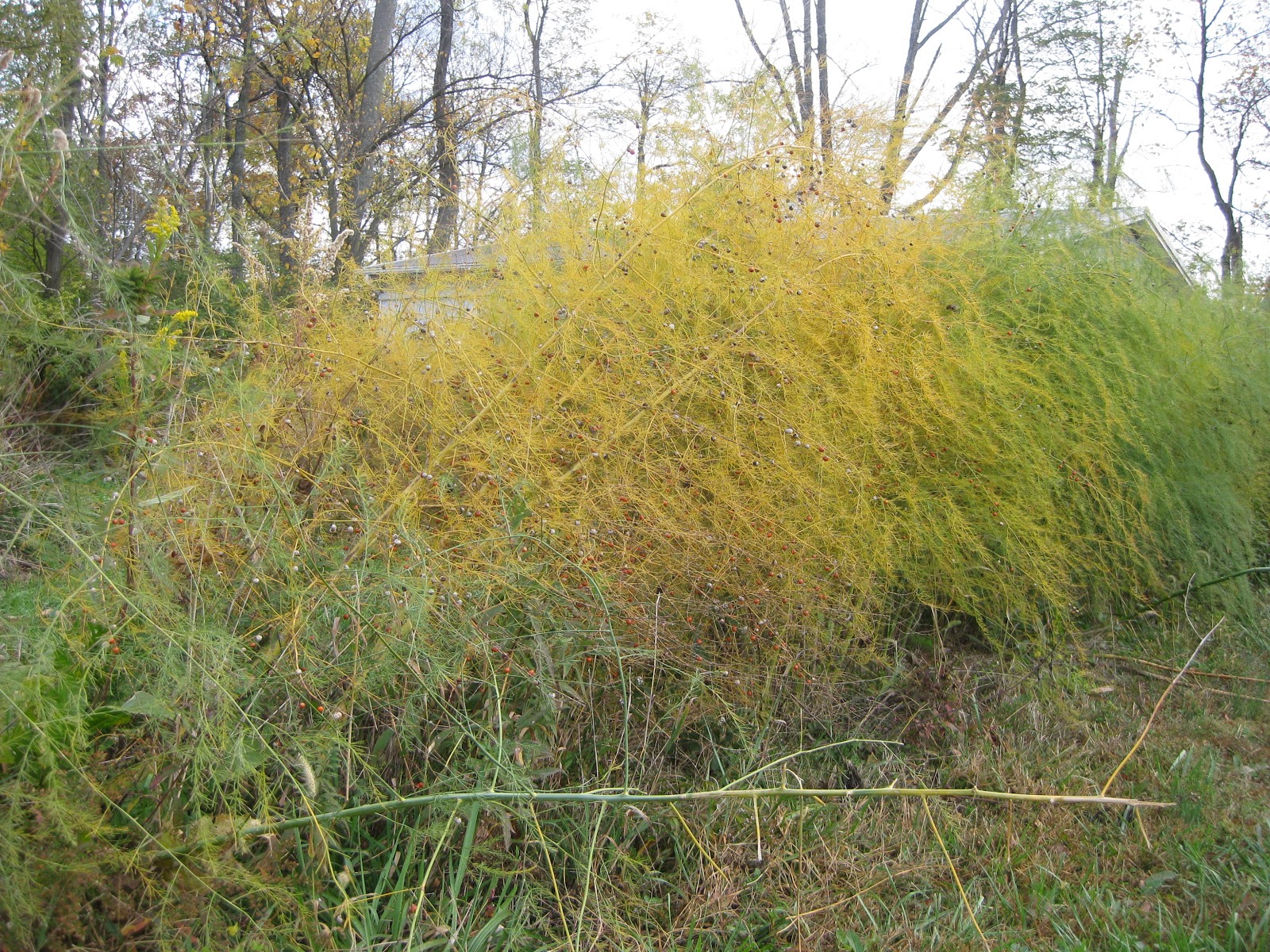
Asparagus starting to turn color
 
The asparagus is starting to turn color from green to golden.  When its totally turned brownish its safe to cut it down and throw the fronds on the compost pile.  Most years I let it stand until spring - but last year I had the big Bush Hog style mower on the tractor most of the winter, so I mowed it down in December.  That was probably a mistake because I had a lot more weeds and grass in the bed this spring.  I weeded a couple of times very early, but the grass took over and at one point in May I picked all the asparagus spears I could find and then mowed the patch very close with my lawn mower.  The ferns are very dense and I'm hoping if I leave them in place all winter they will smother out some of the weeds and grass. 
Red Raspberries still producing as are the weeds!
This is my first year for raspberries.  My brother gave me six plants last fall. I planted them carefully in a slightly raised bed with good drainage, but alas, only three survived.  However, those three have been super producers. I'm still getting a hand full of delicious ripe fruit every other day. In September I was getting about a cup of fruit a day from the three plants.  I have a lot of work to do on the raspberry beds this fall, but I'm encouraged to buy some more plants and expand the patch. Red raspberries are one of the most nutritious fruits you can eat, and are considered the highest in fiber of all the fruits.

The little bit of red color at the base of the trees is a blueberry bush. With the near record September rains and mild weather the weeds have taken over yet again. It's really a good thing we have a killing frost on the way. I'll hopefully have to weed just one more time this fall. These plants were all heavily mulched in June!
Several years ago my garden club visited Marvins Organic Gardens in Lebanon for a gardening talk. Marvin is a great garden information resource and we all enjoyed his presentation very much. At the end of his talk he gave us each a plant. He's also a very generous guy donating whole yards worth of landscape plants to Habitat for Humanity and other worthy causes. 

I received a low bush blueberry plant from Marvin and for the first couple of years it sat in its big gallon plus plastic pot among the ivy and the dogwood tree on the east side of the house. I wasn't too inspired to plant it  because I've always understood that blueberries need a lot of acid in the soil to produce fruit and our soil in very alkaline (high PH). Asparagus does well here because it really likes a high PH.  I kept the blueberry  watered and it had a nice sheltered location, but of course it needed to be planted in the garden.

Finally one spring I got it together and dug a blueberry bed, planted the plant from Marvin's and purchased three more blueberry seedlings, mail order to join it. Since the potted blueberry had continued to grow in its pot, I didn't amend the soil for the PH.   After two years the seedlings gave up and died, but the older plant hung in there.

Last year I converted the blueberry bed to a tree nursery, but kept the one blueberry plant in place. I had purchased a couple of yards of mulch from Tony at Cardinal Landscaping and that gave me plenty of mulch for the garden plants as well as the flower beds around the house. Weeds were out of control this year so  I mulched the raspberries, the tree seedlings and the blueberry plant with the purchased mulch. All of the plants did very well. I haven't tested the soil around them for PH but I suspect that the mulch raised the PH enough to make the blueberry happy because this year, for the first time, the blueberry bore fruit.  The fruit was large and sweet and I am inspired to get back to Marvin's this spring and purchase more of this type of blueberry plant. If all goes well I'll have a good blueberry crop in a year or so.  The leaf color on the plants is also very attractive and will be a stricking backdrop for fall flowers.

Wednesday, October 24, 2012

Baked Apples

Baked apples are another good, wholesome and very delicious dessert.  There are lots of variations on baked apples but I like my mother's recipe the best. It includes raisins and butter and brown sugar, so it has to be good.  Her secret special touch is a slice of Pepperidge Farm raisin bread.

Choose an apple with a little red color for a more appetizing presentation.
The recipe is simple and traditional except for the raisin bread. Instructions here are for one apple, so multiply the directions for multiple apples.

So to begin, thoroughly wash and dry an apple, and core it using an apple corer or a melon scoop, just be sure to take out just the core so you keep the apple flesh.  Core all the way through the bottom of the apple.  Spray a little cooking spray on the bottom of your baking dish and line the dish with a slice of raisin bread.  Mix two teaspoons brown sugar, a teaspoon of raisins and a pat of butter together rubbing the butter and sugar and raisins together with the back of a spoon to form a paste, sort of.  Peel one ring of skin off the top of the apple with a sharp knife. Stuff the cored out cavity of the apple with the sugar paste.  Bake in a 375 degree pre heated oven for 45 minutes to an hour, depending on the size of the apple. You can test for doneness by piercing the side of the apple with a sharp knife. Let the apples cool at least 15 minutes to an hour.  Serve just as they are or add a little buttered pecan ice cream or whipped cream. The butter and sugar mixture will seep into the raisin bread and caramelize, giving you a sweet, chewy bit of toasty bread with every apple bite. The nutrional info for this dessert is at the bottom of this post. Check out all the great fiber content!

Don't get stuck on the idea that only Granny Smith or Golden Delicious can be baked.  Try Jonathen or Jona Gold or one of a dozen other varieties of apples that are good for baking as well as eating out of hand.

This is Melrose, the state apple of Ohio.  I just purchased a 1/2 peck of these from Irons Fruit Farm, and love them for a good all purpose apple. I use them cut up in salads as well as a snack. They also make a lovely baked apple.
Nutrition Facts  for the Baked Apple recipe above.
Serving Size
1 serving (146.8 g)
Amount Per Serving
Calories
238
Calories from Fat
50
% Daily Value*
Total Fat
5.6g
9%
Saturated Fat
2.6g
13%
Cholesterol
11mg
4%
Sodium
129mg
5%
Total Carbohydrates
48.1g
16%
Dietary Fiber
5.7g
23%
Sugars
32.4g
Protein
2.1g
Vitamin A 3%Vitamin C 34%
Calcium 0%Iron 16%
* Based on a 2000 calorie diet


Tuesday, October 23, 2012

Plant Trees in November

A sweet gum and a Washington hawthorn still in their 2010 nursery bed. I'll be transplanting them into the landscape in November. The nursery bed will then receive a new shipments of oak seedlings.
 
How can your turn $10.00 into a $1000 in just three short years?  Join the Arbor Day Foundation.
 
Flowering crab, red bud, sycamore and Washington hawthorn  still in their 2010 nursery bed. I'll be transplanting them into the landscape in November..

Joining the Arbor Day Foundation for just $10 (six months membership) or $15 for the whole year means you get to choose a package of 10 free tree or flowering shrub seedlings.  Plant the seedlings in a nursery bed and within a year  you have nice young trees to transplant into your landscape. Within three years from your first planting your trees will start to increase in value and add beauty your property.
 
You can choose from a variety of packages. Some years I just get a mixed package - like those pictured above.  This year I've opted for a package of oak trees, at least four different varieties. 
 
The oaks seedlings - and I do mean seedlings - will arrive after November 1, so I have time to prepare a nursery bed for them.  They will arrive looking like a collection of dead twigs, most not more than 12 or 18 inches tall.   Plant them carefully and water them at least once a week until the ground freezes, usually in late December or early January here in southern Ohio. Then mulch with straw or other mulch and wait for spring. 
 
You can transplant them next November but I didn't get around to it last year so the trees pictures are two years old.  I'll transplant all but the red buds. They only like to move in the spring. 
 
The Sweet Gums will give me great fall color when they mature a little.  The crab and Washington hawthorn bloom in the spring and provide fruit for wild birds.  All these little trees will add tremendous value to my property and were worth way more than the $10 I spent to join the Arbor Day Foundation.
 
 
Visit the Arbor Day Foundation at www.arborday.org and join today!